Africa's First Government-Organised Environmental Market

Building trusted environmental markets for Lagos, rewarding climate action with sustainable revenue

Lagos Carbon is a structured platform that enables the generation, verification, and monetisation of high-integrity environmental credits from real-world infrastructure.
In collaboration with
LASEPA Ibile Holdings

The state's official environmental credit platform

Lagos Carbon is the State's official market infrastructure, designed to support governments, developers, and investors in creating and trading environmental credits with confidence under the Lagos Standard.

  • Solar and renewable energy projects
  • Energy efficiency and emissions reduction
  • Waste, water and recycling projects
  • Electric vehicle incentive programmes
  • Natural capital and biodiversity projects
  • Air pollution markets
  • EU Carbon Border Adjustment Mechanism (CBAM) compliant initiatives
01

Project Onboarding

Structured assessment and design support to bring eligible projects into the Lagos Carbon framework.

02

Monitoring, Measurement & Verification

Sensor-driven MRV 2.0 with data assurance protocols ensuring credit integrity from day one.

03

Credit Generation & Market Access

Pathways to both voluntary and compliance-aligned markets for I-RECs and carbon credits.

Three steps to environmental credit revenue

Register Your Project Icon

Register Your Project

Submit your project details. Our team conducts an initial assessment and provides a feasibility estimate within days.

Monitor & Verify Performance Icon

Monitor & Verify Performance

Sensor-driven data collection and independent verification ensures credits are traceable and credible.

Generate & Sell Credits Icon

Generate & Sell Credits

Access global buyers — international corporates, institutional investors, and compliance markets.

Built for trust. Designed for scale.

Government-aligned

Developed in collaboration with Lagos State institutions under the Lagos Standard, providing regulatory backing that compliance buyers require.

High-integrity credits

Robust MRV (Measurement, Reporting, Verification) and data assurance at every stage of credit generation.

Market access

Pathways to both voluntary and compliance-aligned markets, with connections to international corporate and institutional buyers.

Developer-first economics

Designed to improve project economics through additional revenue streams, improving bankability and access to global capital.

Illustrative project outputs

The following examples illustrate the type of environmental credit revenue a project can expect to generate under the Lagos Carbon framework.

Solar · Kenya

411 kWp Solar Project

Sample output report illustrating I-REC generation, monitoring methodology, and indicative annual revenue for a mid-scale rooftop solar installation.

Download Sample Report
Solar · Nigeria

1 MWph Solar Project — Polaris Bank

Case study illustrating credit generation and verification for a commercial captive solar installation under the Lagos Carbon methodology.

Download Sample Report

Have a project?

Submit your details and our team will assess your project's eligibility and potential credit revenue.

Submit Your Project

What is Lagos Carbon?

Lagos Carbon is a structured framework for creating and monetising environmental value from real-world projects across Lagos State and beyond.

  • Onboarding eligible projects
  • Applying recognised global methodologies
  • Generating environmental credits (I-RECs and carbon credits)
  • Enabling access to global buyers

Building Global Trust

The Lagos Standard is a structured framework governing the generation, monitoring, verification, and issuance of environmental credits under the Lagos Carbon platform. It ensures all credits are credible, traceable, and aligned with international market expectations.

  • Methodology alignment with global standards for renewable energy and emissions reduction
  • Robust MRV processes ensuring accurate and transparent project performance data
  • Data integrity through sensor technology, anomaly detection, and independent audit access
  • Governance and oversight structures supporting compliance, accountability, and market confidence

How We Fit in the Ecosystem

Project Developers Icon
Project Developers
Lagos Carbon Logo
Lagos Carbon
Global Buyers Icon
Global Buyers

Built for the whole ecosystem

Project Developers Icon

Project Developers

Solar, wind, waste, and efficiency project developers seeking additional revenue streams and improved bankability.

Government Bodies Icon

Government Bodies

Lagos State institutions including LASEPA and Ibile Holdings, providing regulatory backing and enforcement mandate.

Global Buyers Icon

Global Buyers

International corporates, institutional investors, and compliance buyers seeking high-integrity African environmental credits.

Financial Institutions Icon

Financial Institutions

Banks and lenders using environmental credit frameworks to improve project finance structuring and ESG positioning.

Technology Partners Icon

Technology Partners

MRV technology providers and data assurance platforms supporting sensor-driven measurement and verification.

Standard Bodies Icon

Standard Bodies

Gold Standard, Verra, and I-REC alignment ensuring international credibility and buyer acceptance.

Ready to get started?

Submit your project and our team will be in touch within 48 hours.

Submit a Project

Why register your project?

Generate additional revenue Icon

Generate additional revenue

Environmental credits provide a new, recurring revenue stream on top of your existing project economics.

Improve project bankability Icon

Improve project bankability

Credit revenue improves project IRR and makes financing conversations more straightforward with lenders.

Access to global capital Icon

Access to global capital

Connect with international corporates and institutional investors seeking African environmental credits.

Structured onboarding Icon

Structured onboarding

PDD design support and methodology guidance from project submission through to first credit issuance.

Example
1 MW Solar
Annual I-RECs
1,621
Indicative revenue
~USD 15,000/yr

What types of project qualify?

  • Solar and renewable energy projects
  • Energy efficiency and emissions reduction
  • Waste, water and recycling projects
  • Electric vehicle incentive programmes
  • Natural capital and biodiversity projects
  • Air pollution markets
  • EU CBAM compliant initiatives
  • Both existing and planned projects

How onboarding works

1

Submit your project

Complete our simple project submission form with basic details about your installation.

2

Initial screening

Our team conducts an initial Lagos Carbon assessment, typically completed within a few days.

3

Onboarding and PDD design

We provide Project Design Document (PDD) support and methodology selection guidance.

4

Monitoring

Sensor-driven MRV 2.0 is implemented to collect verified generation and performance data.

5

Credit issuance

I-RECs or carbon credits are issued upon verification of performance data.

6

Sale and trading

Credits are sold to international buyers, with Lagos Carbon facilitating market access and offtake.

Submit Your Project
A tradable certificate representing verified environmental benefits such as renewable energy generation or greenhouse gas emissions reduction. Environmental credits allow companies and institutions to substantiate sustainability claims, satisfy ESG reporting obligations, and offset their carbon or energy footprint against an independently verified standard.
An International Renewable Energy Certificate (I-REC) represents 1 MWh of renewable electricity generated and independently verified. I-RECs are used by companies to report reduced Scope 2 emissions under the GHG Protocol and are accepted by CDP, RE100, and other leading ESG reporting frameworks. They are a distinct instrument from carbon credits and derive their value from the renewable attribute of the generation, not from avoided emissions.
This requires careful structuring. Both instruments derive value from the same underlying generation event, so concurrent issuance requires one instrument to be cancelled before the other is issued — otherwise the same MWh is claimed twice, which constitutes double counting. Lagos Carbon's team will advise on the optimal credit strategy for your project. In practice, the choice depends on buyer demand, price dynamics, and the project's financial structure at any given time.
Lagos Carbon supports solar and renewable energy projects, energy efficiency and emissions reduction, waste, water and recycling projects, electric vehicle incentive programmes, natural capital and biodiversity projects, air pollution reduction, and EU Carbon Border Adjustment Mechanism (CBAM) compliant initiatives. Both existing operational projects and projects in development are eligible for assessment.
Credits are sold to international buyers including corporations with net zero and sustainability commitments (particularly RE100 members and CDP-reporting companies), institutional investors seeking impact investments, and governments or sovereign entities in some cases under Article 6 frameworks. Lagos Standard-badged credits target the premium segment of this buyer universe — buyers with the most stringent ESG obligations who require independently verifiable confidence in the credits they purchase.
The Lagos Standard is a certification overlay — not a competing methodology. It does not replace Gold Standard, Verra VCS, or Article 6.4. It builds on them. A credit must already satisfy one of these internationally recognised frameworks as a condition of Lagos Standard eligibility. The Standard then adds further layers of assurance: sovereign regulatory endorsement by LASEPA, real-time digital transparency via the Lagos Carbon Hub, and independent stakeholder access — attributes no VCM standard currently provides at scale. The relationship is Lagos Standard ⊇ CCP: Lagos Standard credits are a higher-assurance subset of CCP-eligible credits, not an alternative to them.
The Lagos Standard recognises a defined and regularly reviewed list of international standards. Currently eligible frameworks include: Gold Standard for the Global Goals (GS4GG), including the genset replacement methodology developed with SE4All; Verra Verified Carbon Standard (VCS/VCM); Paris Agreement Article 6.4 Mechanism credits (initially limited to the approved landfill gas methodology, with further methodologies added as approved); the Climate, Community & Biodiversity Standards (CCB) applied in combination with VCS or Gold Standard; the I-REC Standard for energy attribute certificates; Puro Earth Biochar; and I-TRACK (G) for biogas and biomethane. Standards not on this list must go through a formal addition process involving technical review, a 30-day public comment period, and LASEPA determination. Approved additions are gazetted and published on the Hub.
The Lagos Standard is explicitly designed to be complementary to — and subordinate to — any federal Article 6 framework or national registry. It does not purport to authorise corresponding adjustments: that authority rests with Nigeria's National Climate Change Commission (NCCC). Credits meeting Lagos Standard requirements are designed to satisfy the quality criteria typically demanded by Article 6 counterparties, facilitating potential federal authorisation without rework. The Lagos Carbon Hub will be designed to interface with any national registry established by the NCCC, and LASEPA will formally notify and invite federal observer participation in the Lagos Standard Governance Committee.
No. The Lagos Standard is not a separately applied badge with its own application process or fee. It is the automatic consequence of a credit having passed through every layer of the Lagos Carbon Hub's digital assurance architecture. A project operating under an approved international methodology that generates credits through the Hub's full MRV pipeline receives the Lagos Standard automatically — there is no separate application, no additional bureaucratic step, and no additional fee. This design is itself the most significant equity feature of the Standard: smaller developers do not face an additional financial hurdle to access it.
The relationship is best understood through the analogy of a securities regulator and a stock exchange. LASEPA sets the rules and oversees their application — as a regulator does. Lagos Carbon operates within those rules and has a powerful commercial incentive to enforce them rigorously, because the premium value of Lagos Standard credits depends entirely on the credibility of the assurance process — as an exchange does. The immutable Hub audit trail, accessible to LASEPA at all times independently of Lagos Carbon's representations, ensures LASEPA can always verify compliance itself. The transparency mechanism resolves the apparent conflict: LASEPA does not rely on Lagos Carbon's word — it reads the data directly.
The Provisional badge is a time-limited status for projects that are registered under an approved methodology and have commenced the Hub's digital MRV pipeline, but have not yet completed a full independent verification cycle. Provisional status may be held for a maximum of 18 months. Provisional credits carry a clear digital marker visible to all Hub users including buyers and LASEPA — it cannot be removed or obscured. They may be listed and sold on the Hub at a discount to full Lagos Standard credits, but may not be represented as full Lagos Standard credits and cannot satisfy buyer commitments that specifically require full Standard compliance, including CDP, RE100, or Article 6 reporting. Credits sold and retired at Provisional status are not retroactively upgraded.
No. Both existing operational projects and projects in development can be assessed. Lagos Carbon can support you from the feasibility and project design stage through to monitoring, verification, and credit issuance. Early engagement is encouraged — getting the project design right from the outset avoids costly rework later in the certification process.
Yes. A Managed Migration Pathway is available for existing credible projects that pre-date the Lagos Carbon platform. Migration requires: a full data room submission of historical MRV records; a Hub compatibility assessment; onboarding of future monitoring cycles into the Hub's real-time data pipeline; independent verification of the migration; and digitisation of the applicable methodology into the Hub. Only future credits generated through the Hub's digital pipeline after successful migration will be eligible for the Lagos Standard. Credits already issued and retired are not eligible for retroactive badging, and crediting cannot run concurrently under two frameworks.
Yes. A listing pathway is available for projects outside Lagos State where: the project is registered under an internationally recognised methodology that Lagos Carbon has digitised; it meets all Lagos Standard qualifying conditions; and LASEPA obtains a No Objection Letter from the relevant state environmental authority, or confirmation that no equivalent state-level registry exists. This pathway is designed to enable the Lagos Standard to expand geographically as the platform matures.
An initial Lagos Carbon assessment is typically completed within a few days of submission. Full onboarding — including project design documentation, methodology selection, sensor installation, and Hub registration — depends on the project's complexity and readiness. Our team provides a clear timeline at the outset. All onboarded projects receive a dedicated onboarding manager for the first 90 days of Hub registration, with direct support available via WhatsApp, email, and in-person meetings where required.
Lagos Carbon provides a structured capacity-building programme for smaller and community-based developers, including: a structured digital walkthrough of the Hub's certification workflow tailored to the applicable methodology; a baseline data requirements checklist so developers know exactly what to collect before sensors are installed; subsidised MRV services for qualifying community projects at not more than 50% of the standard commercial rate, funded from the Community Project Support Fund; hardware-as-a-service arrangements for sensor installation where upfront capital is not available, with costs recovered from future credit revenues; biannual cohort-based support for up to ten small developers sharing a verification pool to reduce per-project verification costs; and the annual Lagos Carbon Academy, delivered in partnership with a Lagos-based university, covering carbon market fundamentals, Hub workflows, MRV data collection, and verification preparation — with a Yoruba-language track where demand warrants. Lagos Carbon is also shortlisted as a Certification Partner for the Net Zero programme being developed by NGX and DEG, the German Development Finance Institution.
Pricing is based on project size and scope. There is no separate Lagos Standard application fee — the Standard is an automatic output of the Hub's digital assurance process. Lagos Carbon operates a tiered fee structure to ensure that smaller and community-based project developers are not disadvantaged. A Community Project Support Fund, cross-subsidised from the registry fees of mid-tier and larger developers, funds subsidies and hardware-as-a-service arrangements. All fees are denominated in USD but payable in Nigerian naira at the prevailing CBN rate. Early-stage estimates are provided at no cost during the initial assessment.
Lagos Standard credits carry seven layers of digital assurance, all recorded immutably on the Lagos Carbon Hub and accessible to buyers independently of Lagos Carbon or the project developer. These layers cover: methodology compliance under an internationally recognised standard; sensor-verified MRV data with real-time anomaly detection; AI-assisted certification workflow review; independent third-party verification; LASEPA regulatory attestation; complete historical audit trail; and real-time status visibility. A buyer can verify every credit's complete lifecycle — from project registration through to issuance and retirement — directly on the Hub without relying on any party's representations.
Full Lagos Standard credits are designed to satisfy the quality criteria required by CDP, RE100, and — subject to federal authorisation by the NCCC — Article 6 counterparties. They are built on top of IC-VCM Core Carbon Principle-eligible methodologies and carry the additional assurance layers that premium ESG reporting frameworks demand. Provisional Lagos Standard credits do not satisfy these requirements and should not be used for CDP, RE100, or Article 6 compliance purposes. Buyers should confirm the credit's full or provisional status on the Hub before purchase for compliance purposes.
Yes. Because the Lagos Standard is an output of a fully documented and auditable digital process, the evidential record for any credit dispute is available in full on the Hub. A buyer with a concern about a credit's Standard status can: access the complete audit trail directly on the Hub; raise a formal query with Lagos Carbon's registry team, who are required to respond within 10 business days; and escalate to LASEPA's oversight function if the concern relates to regulatory compliance. LASEPA retains the authority to identify and flag credits it considers non-compliant with the Standard's framework and to require Lagos Carbon to investigate. The Hub audit trail provides the complete evidential record for any such review.
Lagos Standard credits are expected to command a price premium over equivalent voluntary carbon market credits, reflecting the combination of sovereign regulatory backing, technology-enforced data integrity, real-time transparency, and independent access that the Standard provides. Lagos Carbon publishes indicative pricing data for both full Lagos Standard and Provisional credits on the Hub, providing buyers with transparent price discovery. The premium will be validated through early anchor buyer transactions and published as market evidence becomes available.

Have a question not covered here? Our team is happy to help.

Get in Touch
Section 1 — Contact Details
Section 2 — Project Details
Section 3 — Description
Thank you — our team will review your submission and respond within 48 hours.

Get in touch

Whether you have a project to submit or just want to learn more, our team is happy to help.

Within 48 hours
Lagos, Nigeria

Not ready to submit?

Download one of our sample project reports to understand what the process looks like and what economics to expect.

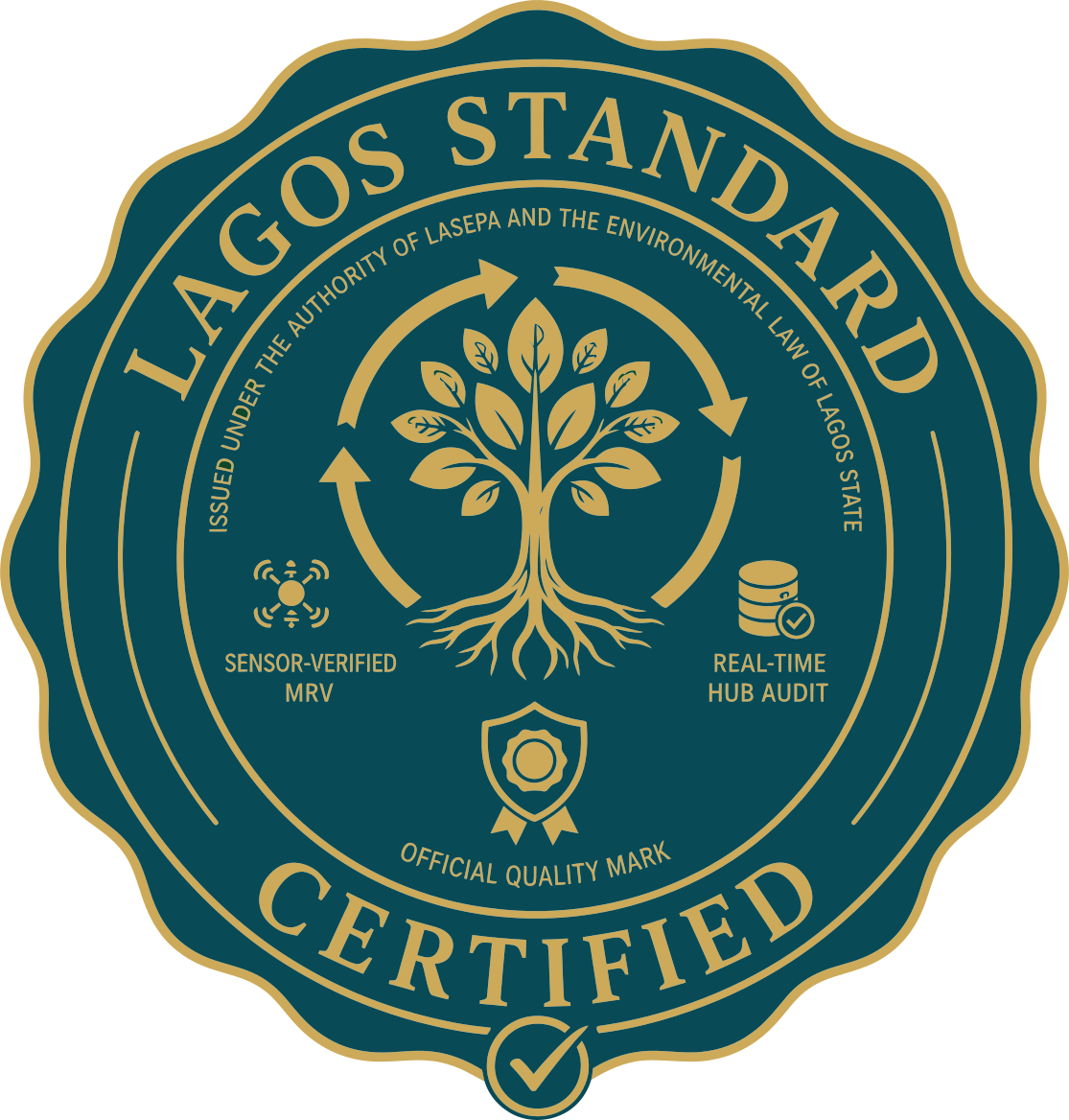
Official Quality Mark

The Lagos
Standard

A badge of exceptional trust — applied exclusively by LASEPA to environmental credits generated, verified, and issued through the Lagos Carbon platform. Going materially beyond what voluntary carbon markets alone can assure.

Talk to Us About Your Project
Lagos Carbon Certification

Issued under the authority of LASEPA and the Environmental Law of Lagos State

Sensor-verified MRV data
Real-time audit trail on Hub
LASEPA regulatory attestation
Independent stakeholder access

Not a methodology. A certification overlay.

The Lagos Standard is not a carbon methodology in its own right. It is a quality designation — applied by LASEPA on top of internationally recognised standards — that signals a credit has been produced under conditions of exceptional rigour, transparency, and independent verifiability that the voluntary carbon market alone cannot provide.

The Standard applies to carbon credits, Certificates of Emissions Reduction (CERs), and Energy Attribute Certificates (EACs) — including I-RECs — issued through the Lagos Carbon platform. It sits closer to a compliance market standard than an ordinary VCM credential, backed by LASEPA's statutory enforcement powers under the Environmental Law of Lagos State.

Four conditions. All four. Every time.

A credit only receives the Lagos Standard badge when all four conditions are satisfied simultaneously — there are no exceptions and no partial awards.

Internationally Recognised Methodology Icon

Internationally Recognised Methodology

The credit must be generated under a methodology recognised by Gold Standard, Verra (VCS), the Paris Agreement Article 6.4 Mechanism, or an equivalent internationally accepted standard — as digitised within the Lagos Carbon technology architecture.

Certification Rigour Icon

Certification Rigour

The credit must be produced through Lagos Carbon's digital MRV pipeline: sensor data ingestion with real-time anomaly detection; AI-assisted certification workflow guidance; and a fully digital, independently verified audit trail from registration through issuance.

Full Process Transparency Icon

Full Process Transparency

Every stage of the credit's lifecycle — from project registration and baseline establishment through monitoring, verification, and issuance — is recorded immutably within the Lagos Carbon Hub, accessible in real time or via complete historical logs.

Independent Stakeholder Access Icon

Independent Stakeholder Access

The full credit lifecycle record is made directly accessible — without intermediation by Lagos Carbon or the project developer — to project finance investors, credit off-takers, LASEPA, and other key stakeholders. Independently. In real time.

The Commercial Case

Trust translates directly into price

The Lagos Standard is designed to achieve a measurable price premium over equivalent voluntary carbon market credits. Buyers with the most stringent ESG obligations — compliance buyers, Article 6 counterparties, RE100 members, and CDP-reporting corporates — need independently verifiable confidence. The Lagos Standard delivers exactly that.

Real-time
Credit lifecycle visibility via Hub
LASEPA
Statutory regulatory backing
Gold Std.
+ Verra aligned methodologies
AI MRV
Sensor-driven verification

Applied by LASEPA. Under statute. Not by the platform.

The Lagos Standard cannot be self-awarded by a project developer or the Lagos Carbon platform operator. It is applied exclusively by LASEPA — and only when both sources of authority are present simultaneously.

Statutory Powers

LASEPA's authority to issue the Lagos Standard derives from powers conferred by the Environmental Law of Lagos State — giving the badge genuine legal weight that no voluntary standard body can replicate.

Market Oversight Role

LASEPA serves as the regulatory oversight body of the Lagos Carbon compliance market, with the mandate and enforcement capability to monitor, investigate, and act on any credit integrity concerns.

Technology Independence

LASEPA has direct, independent access to the Lagos Carbon Hub — not mediated by the platform operator. This ensures the regulator can verify credit records without relying on the commercial entity it oversees.

Governance Framework

A Lagos Standard Governance Committee, chaired by LASEPA with independent technical and buyer representation, oversees the Standard's requirements and conducts annual reviews to maintain alignment with global market evolution.

Who Benefits

Built for the whole ecosystem

The Lagos Standard creates trust at every node of the environmental credit value chain.

Project Finance Investors Image

Project Finance Investors

Real-time access to verified credit generation data — directly from the Hub, independently of the project developer — transforms environmental credit revenue from a promised cashflow into a verifiable one. The Lagos Standard is the assurance framework that makes credit revenue bankable.

Corporate Credit Off-takers Image

Corporate Credit Off-takers

RE100 members, CDP reporters, and Article 6 counterparties need credits they can defend to their own auditors and regulators. A Lagos Standard badge — backed by LASEPA's statutory authority and a complete, independently accessible audit trail — provides that defensibility.

Project Developers Image

Project Developers

The Lagos Standard premium directly improves your project economics. Credits bearing the badge command a higher price from premium buyers. The transparent certification process also strengthens your relationship with lenders and equity investors who require assured revenue forecasts.

Ready to generate Lagos Standard credits?

Submit your project and our team will assess eligibility under the Lagos Standard framework.

Submit Your Project